
Monsoon, Minerals, and the Battle for India's Acoustic Sovereignty
“The seabed is fast becoming the next strategic frontier”
— UN Secretary-General António Guterres
The global push toward a net zero future has reached an uncomfortable contradiction. To decarbonize the atmosphere, the world is preparing to disturb the most stable carbon sink on the planet: the deep ocean. While much of the global debate focuses on whether deep sea mining is technically possible, in the Indian ocean the issue is far larger than mineral extraction. As India works toward its target of 500 gigawatts of non-fossil energy capacity by 2030, the road to decarbonisation is now extending far below the surface of the ocean. While global debate remains focused on the Pacific’s Clipperton zone, for New Delhi the Indian Ocean seabed represents a deeper strategic shift in how power and security are shaped in the sea. By 2030, deep sea mining will sit at the crossroads of India’s energy security, China’s expanding undersea presence, and mounting environmental risk. What is emerging is not just a debate about resources, but a challenge with implications for energy, climate and regional stability.
The Myth of Green Abyss and India’s Vulnerability.
The claim that the deep sea holds a green solution for our energy transition is appealing, but it obscures deeper strategic risks. Polymetallic nodules, which litter the abyssal plains of oceans, contain metals such as manganese, nickel, copper and cobalt- all essential for batteries and renewable energy technologies. India currently holds exploration rights of over 75000 sq.km area in the central indian ocean basin, where estimates suggest around 366-380 million tonnes of polymetallic nodules lie beneath the seafloor, containing significant quantities of these metals. Much of the country’s clean energy transition– from EV’s to grid storage- depends on metals that are currently imported in large quantities. Deep sea minerals could, in theory, offset some of this dependence and contribute to energy security as India scales renewable capacity.
However, The deep ocean is fast becoming a contested space as it is still in an exploratory phase: no commercial mining is operational, even though the International Seabed Authority (ISA) has issued over 30 exploration contracts globally for polymetallic nodules, sulphides, and cobalt crusts. The regulatory framework is still being finalised, and commercial extraction could take years to start- long after geopolitical stakes have hardened.
Thus, the deep ocean is rapidly becoming a zone of geopolitical competition and exclusionary control, not just resource access. As the exploration (dual-tech) technology becomes accessible, nations are mapping, sensing and controlling undersea terrain. For India, pursuing a green transition without control over the seabed risks turning the ocean from a resource opportunity into a security vulnerability.
China’s Acoustic Sovereignty vs. India’s Undersea Domain Awareness
China’s Deep sea ambitions are not ad hoc experiments but the outcome of a strategic vision, institutional backbone, and global positioning. Under President Xi Jinping, deep sea mining has been elevated as a
priority, explicitly written into the 13th and 14th Five-Year Plan, and aggressively framed as central to building a “Blue Economy.” At its core lies the drive to secure critical minerals- cobalt, nickel, copper and rare earths-vital economic growth and energy transitions.
Through COMRA, China has emerged as the largest holder of exploration contracts with the International Seabed Authority (ISA) pairing legal access with sustained investment in deep sea technology. This has given Beijing a cumulative advantage not only in resource access but also in systematically mapping large portions of the global deep seabed. By contrast India’s decision in September 2025 to secure a 15 year ISA contract covering roughly 10,000 square kilometers of the Carlsberg Ridge marked a deliberate effort to narrow this gap. Becoming the first ISA member with two active contracts, India signaled a shift from passive participation to a capability driven presence and a clear commitment to building Underwater Domain Awareness (UDA).
Deep sea mining technologies are inherently dual-use. The AUVs, seabed sensors, and high resolution bathymetric mapping systems- developed ostensibly for mineral exploration are equally critical for identifying underwater terrain, acoustic corridors, and submarine transit routes. China’s sustained investment in deep-sea research vessels, underwater sensor networks, and long duration submersibles allows it to accumulate persistent seabed intelligence. If this asymmetry continues, India risks operating in an undersea environment increasingly defined by data collected, processed and controlled by an external power- resulting not just in reduced resources access but a gradual erosion of acoustic sovereignty.
Beyond technology, China’s economic and infrastructure engagements in states like Sri Lanka and the Maldives have deepened its strategic leverage in the Indian Ocean. China’s large scale investments in ports and infrastructure have raised concerns over Beijing’s maritime presence at the expense of India’s traditional regional role.
These risks are already visible. India’s application to explore Afanasy-Nickitin Seamount- an undersea feature rich in minerals like cobalt, nickel, and manganese- has been complicated by overlapping claims, including from Sri Lanka, under the United Nations Convention on the Law of the Sea (UNCLOS). This dispute underscores how seabed access is becoming a new source of diplomatic friction in South Asia intensifying great power competition.
The Climate Nexus:
Perhaps the most overlooked analytical angle is the climate-security nexus. The deep sea is the world’s largest carbon vault, and mining operations generate sediment plumes that can spread hundreds of kilometers, threatening the ocean’s “biological pump”, that regulates heat and carbon. For South Asia, this is not an abstract concern, the Indian ocean plays a central role in shaping its climate, especially the Indian summer monsoon, which supports agriculture and livelihoods across the region. Scientific research shows that sea surface temperatures, ocean circulation, and subsurface conditions in the Indian Ocean are linked to monsoon strength and rainfall patterns over India.
Disturbances to deep-sea environments- such as sediment plumes from mining activity- could theoretically affect local ocean chemistry and biological processes, though the full scale of these effects remains uncertain and is an active subject of scientific study. The deep ocean is also closely coupled with upper- ocean processes that feed into monsoon behaviour, so monitoring and understanding these systems is critical for long-term climate resilience. For India, where monsoon rainfall underpins agriculture, water resources, and economic stability for hundreds of millions of people, ocean influences on monsoon dynamics are more than academic. If large-scale mining disrupts the ocean’s ability to regulate heat and carbon, the resulting unpredictability in weather patterns would be a threat multiplier. A failed monsoon leads to agricultural collapse in the Indo-Gangetic plains, which leads to mass migration, which leads to border conflicts.
In this light, deep sea mining is a form of ecological sabotage. Scientific observations and forecasting systems- like those developed by India meteorological Department partners-underscore the value of robust ocean monitoring for climate and disaster preparedness. If an external power like China dominates the data and the technology of the deep sea, they don’t just control the minerals; they hold the region’s climate resilience hostage.
India’s strategic pivot: Samudrayaan and beyond
India’s deep ocean mission is overseen by the Ministry of Earth Sciences (MoES) and implemented through coordinated efforts with institutions such as the National Institute of Ocean Technology (NIOT), National Institute of Research Organisation(ISRO), and other scientific agencies. Approved in 2021 with a budget of 4077 crore rupees over five years, DOM supports development of underwater technology, climate advisory services, biodiversity research, and deep sea survey systems.
A central element of this effort is Samudrayaan, India’s first manned deepsea mission.
At its heart is Matsya-6000, an indigenously developed crewed submersible designed to carry three aquanuts to depths up to 6km beneath the ocean surface. The vehicle’s lithium alloy personnel sphere and life-support systems are being realised by the Indian Space Research Organization (ISRO) and other research partners. When operational, Matysa-6000 will place India among a small group of nations-including the United States, Russia, China, Japan, and France-with human rated deep sea exploration capacity.
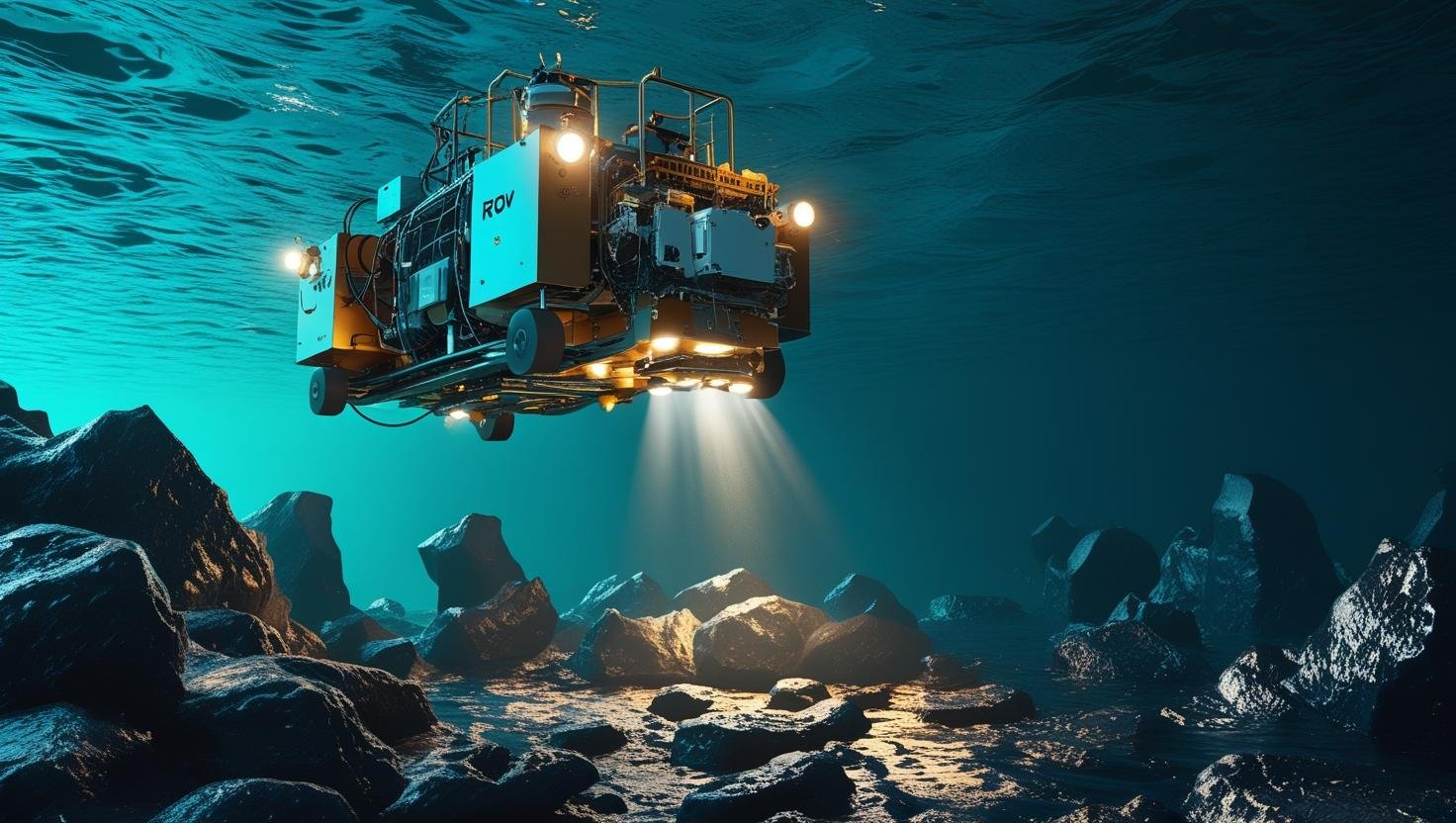
Moreover, India’s DOM is building advanced AUVs, ROVs, and ocean-climate monitoring systems to strengthen seabed mapping, undersea surveillance and governance of ocean resources. Complementing this. India joined the QUAD critical minerals initiative (2025) with the US, Japan, and Australia to diversify lithium, cobalt, and nickel supply chains. The next step is a regional framework treating the seabed as a shared security and environmental space, not just a mining zone.
Conclusion
The abyss is no longer empty, It is being filled with the ambitions of New Delhi and the anxieties of a warming planet. For India the deep sea is a new frontline. If the Nation allows the seabed to be carved up without indigenous control, it will lose more than just nickel it will lose the ability to secure its waters and protect its climate.
The challenge for India in 2026 is to ensure that the quest for a green future does not lead to a blue collapse. In the deep ocean, the darkness doesn’t just hide riches, it hides the next great shift in the global balance of power.

